
Antony Clarkson
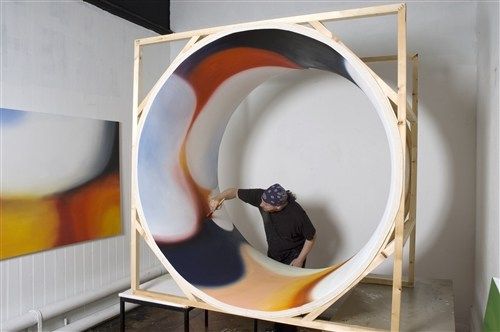
From being a child, I have always been drawn to the arts. Graduating from Manchester School of Art with a BA & MA in fine art in 2009 I set up a studio whilst working as a docent at the Whitworth Art Gallery. I have been greatly influenced by my travels and in 2011 I began a series of International Artist Residencies creating situation-specific installations for art galleries globally, including the Sichuan Academy of Fine Art and the 501 Artspace, Chongqing, China, The Finnish Academy of Fine Art, Helsinki, Finland, Monster Truck Gallery, Ireland and the CFCCA in Manchester, UK. When in Manchester I became a Co-director at Mirabel Studios Gallery and began lecturing as Course Coordinator and Senior Lecturer at The Independent Art. In 2018 I moved to Athole House Studio in Scotland using it as a base to create whilst continuing to exhibit and lecture both nationally and internationally. Recently I have relocated to Cardinal Red Studio, Virginia in the USA where I am producing a new body of work based around the idea of Apophenia which I will start exhibiting soon.
ARTIST’S STATEMENT
Antony Clarkson Artist Statement: The Apophenia Series.
Apophenia: the tendency to perceive a connection or meaningful pattern between unrelated or random things (such as objects or ideas).
My work across painting, sculpture and installation explores the intersections between perception, space, and memory. It is my intention to open new ways of seeing and experiencing the world, offering audiences opportunities to pause, reflect, and reconsider.
The paintings in the Apophenia Series are pure abstraction, drawn from my own experience and memory. They are created to ask the observer to reconsider their preconceived perceptions of the world by providing them with forms that have an uncanny familiarity about them without being anything absolute. They have a form of anthropomorphism, but a distant one being just suggestive enough that they deliberately lead the observer. Some parts may lead in a certain direction whilst others may contradict that idea and propose a different one. Certainly, if one tries to hang too fixed a notion of ‘depiction’ on one of these paintings you are destined to end up confused and lost, like trying to use an Esher image as a blueprint for your home.
My research for this project has led me to some very interesting reading, which has broadened my thinking on the subject into a consideration of how the brain generally makes sense of the messages coming from the eyes and indeed via all of the senses. The latest thinking on these optical processes is that we don't really see every detail of exactly what is in front of us. Indeed, it now appears likely that the brain creates a substantial part of what we see, based on what it expects to see, and only adds extra details, or corrections based on new information from the eyes. Effectively, the brain joins the dots. It makes connections based on a balance of limited information and memory, effectively it uses preconceptions. But what if the image suggested by the conjunction of those dots is fallacious? Then as with my paintings we are into the realms of apophenia.
Not all that we see is perhaps as straight forward as we think and I hope to give my audience space to consider this through their interaction with my work.