
Demetrios Papakostas
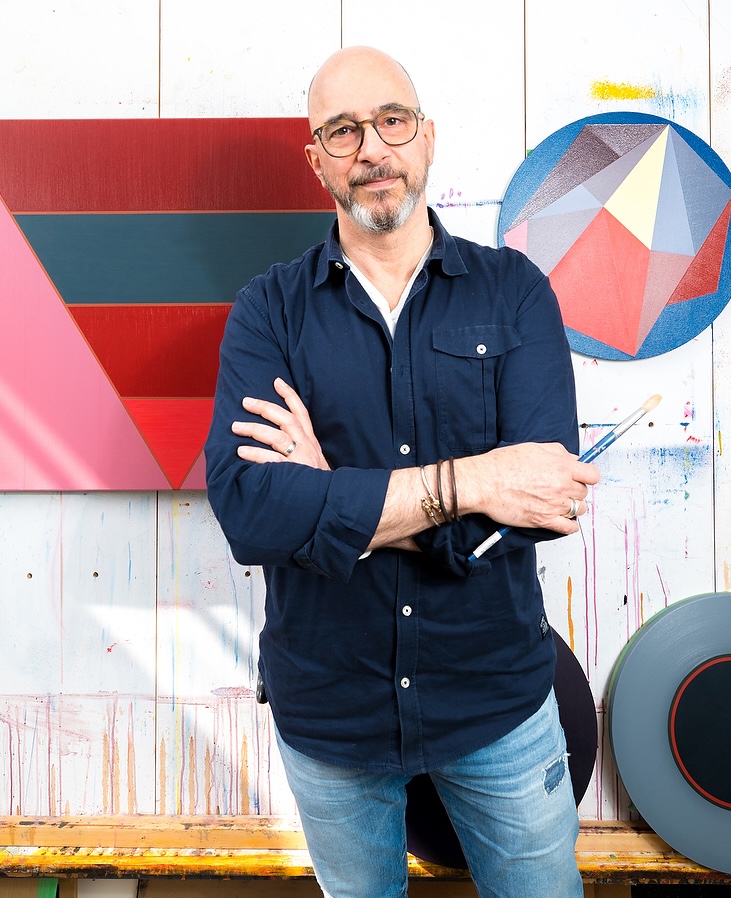
Born in 1960 in Montreal, Canada, Demetrios Papakostas began painting in 2001 and to a fulltime art practice in 2011. Prior to this, he worked as a graphic artist while pursuing part time studies at Concordia University’s evening arts programme. Further studies at Montreal’s Visual Arts Centre and the Saidye Bronfman Centre allowed him to work with such artists as Nicole Lebel, Heather Yamada and prominent Canadian Painter Harold Klunder.
Focusing on the most basic visual elements of colour, line, and form, the artist’s work attempts to initiate conversations and experiences with himself and the viewer. While hard-edge abstraction generally defines his work, he considers his process one of discovery and spontaneity, allowing him to probe issues of human perception and our relationship to nature, place, and time. More recently Papakostas’ work attempts to move beyond the either/or polarity of geometric or expressive abstraction.
In addition to his art practice, Papakostas is the founder and director of his own gallery, a rental space where he also manages and curates exhibitions, including "Art Sur Papier", an annual art exhibition he founded in 2021 dedicated to works on paper. He also collaborates with other artists to curate group exhibitions such as “Degel”, "Articulations" and the exhibition, “Being Constructiv” in 2025.
The artist has participated in exhibitions at Galerie McClure, Galerie Espace, Galerie E.K. Voland, Galerie Beaux Arts des Ameriques, Galerie Erga, Galerie de la Ville, McBride Contemporain, Montreal’s Archive Contemporain, Art Zone 42 Gallery in Athens, Greece, as well as at 1515 Lincoln Gallery, Oklahoma City, US.
His work is in private and corporate collections in Canada and the US. Papakostas is represented by 1515 Lincoln Gallery in Oklahoma City, USA and Denison Gallery in Toronto, Canada.
ARTIST’S STATEMENT
I am drawn by the possibilities the work affords for discovery of the unexpected.
As an artist, I am concerned with the most basic visual elements: colour, line and form.
My artistic choices are primarily focused on the myriad possibilities of their combining
and the opportunity they present to initiate conversations and experiences, within myself
and within the viewer.
Colour is foremost a place where self and nature, the personal and universal meet.
Two different colours touch, at times drawing us further into the work, below the
surface, at times into ourselves.
At other times, colours hold each other in place, reverberating with a vital tension, enhancing each other or moving outward and beyond the surface.
Line creates direction, presents a choice through which I feel my way forward.
Especially when combined with colour, line determines spatial perception.
Though each piece begins with a definite idea, the work rarely allows me to know what
direction it will take or when it will be complete. Primarily working in oil, I start by
building layers of form and colour and proceed intuitively, continuously changing,
covering up, even discarding certain elements as I proceed.
The constant rethinking and reworking of the surface fascinate me. They are important
steps in my internal search for the intangible, yet a necessary connection with the work.
While hard edge abstraction, which could generally define my painting, is considered
objective, the process for me is also deeply personal; through that process I probe
questions of meaning about life’s journey, our relationship to, and place in the universe.
Colour and line are as emotive as they are conceptual.
More recently I have been attempting to move past the polarity of geometric or
expressive abstraction. How might they dialogue in ways that maintain an aesthetic
rigour?
February
2025