
Louise P. Sloane
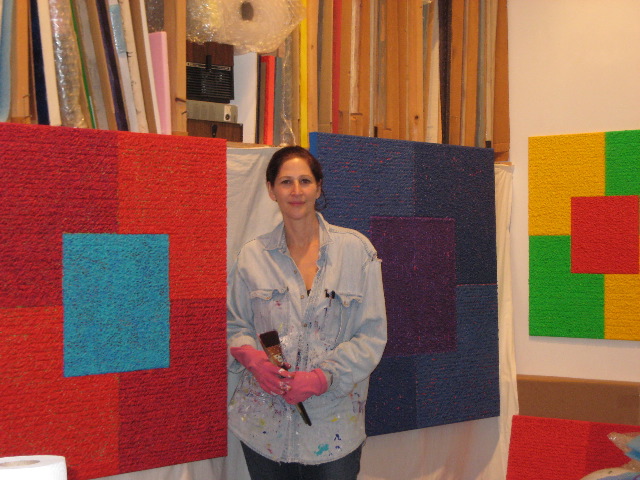
From Lilly Wei's catalog essay for "Back to The Future: The Paintings Of Louise P. Sloane. Works From 1976-2022" Spanierman Modern, NYC. 2024.
"Louise P. Sloane has been making paintings for around five decades, give or take a few years, a pursuit she still finds engrossing, not surprising in a medium that has served humans as a means of expression for millennia—surely passing the test of time. From the 1970s onward, Sloane—who is a maximalist posing as a minimalist—has focused on structure, materiality, texture, text, and, above all, color. Her surfaces were often pared down to one or two hues in her early work but eventually, she added more, at first mostly subsurface, the multiple layers sandwiched beneath adding depth and density to the painting while the reflection and refraction of physical light skittering across the surface activated its subtle luster. Often working in series, Sloane has opted for a progression that is slow, meticulous, suited to her temperament, the paintings submitted to an exhaustive investigation of combinations and permutations, reveling in a process that is hands-on, empirical, and adamantly not predetermined. Instead, she asks herself constant questions, finding the answers to them in the paintings as she proceeds—as well as new questions. " Lilly Wei 2024
ARTIST’S STATEMENT
The visual language of my paintings embraces the legacies of reductive and minimalist ideologies, while celebrating the beauty of color, and the human connection to mark making. The way the brain registers color, movement and spatial/geometric relationships is at the heart of my work.
The work focuses upon geometric forms, grids and patterns. These detail oriented works are typically divided into rectangles or squares. The square as a repetitive motif, along with the grid provides structure for all of these paintings. Similar compositional principles underlie each work with some slight modifications. Commonly the image is divided into five parts: four rectangles and a square. My muse may be centered or floating through the pictorial plane, usually alone, but sometimes with other squares. Whether the square is dimensionally similar to the outer rectangles or not, it always dominates, creating a central core for the flow of the painting. Not wanting to obfuscate the traditional precepts of reductive art, my goal has been to utilize this rich past and move forward through my own modifications and additions. The flaws and imperfections of the repetitive handmade patterns and physical motion and depth of paint are accentuated by the geometric formalities within the paintings’ structure. Information has been encoded in lines and patterns throughout human history, and the work connects me to this personal past. Complex color contrasts intensify the texture’s dimensionality and compete for the viewer’s focus, keeping the eyes and mind in constant motion, fusing my interests in geometry, color, and light.
Regardless of the painting’s texture and color, the square prevails, providing harmony and unity.