
Christie Baker
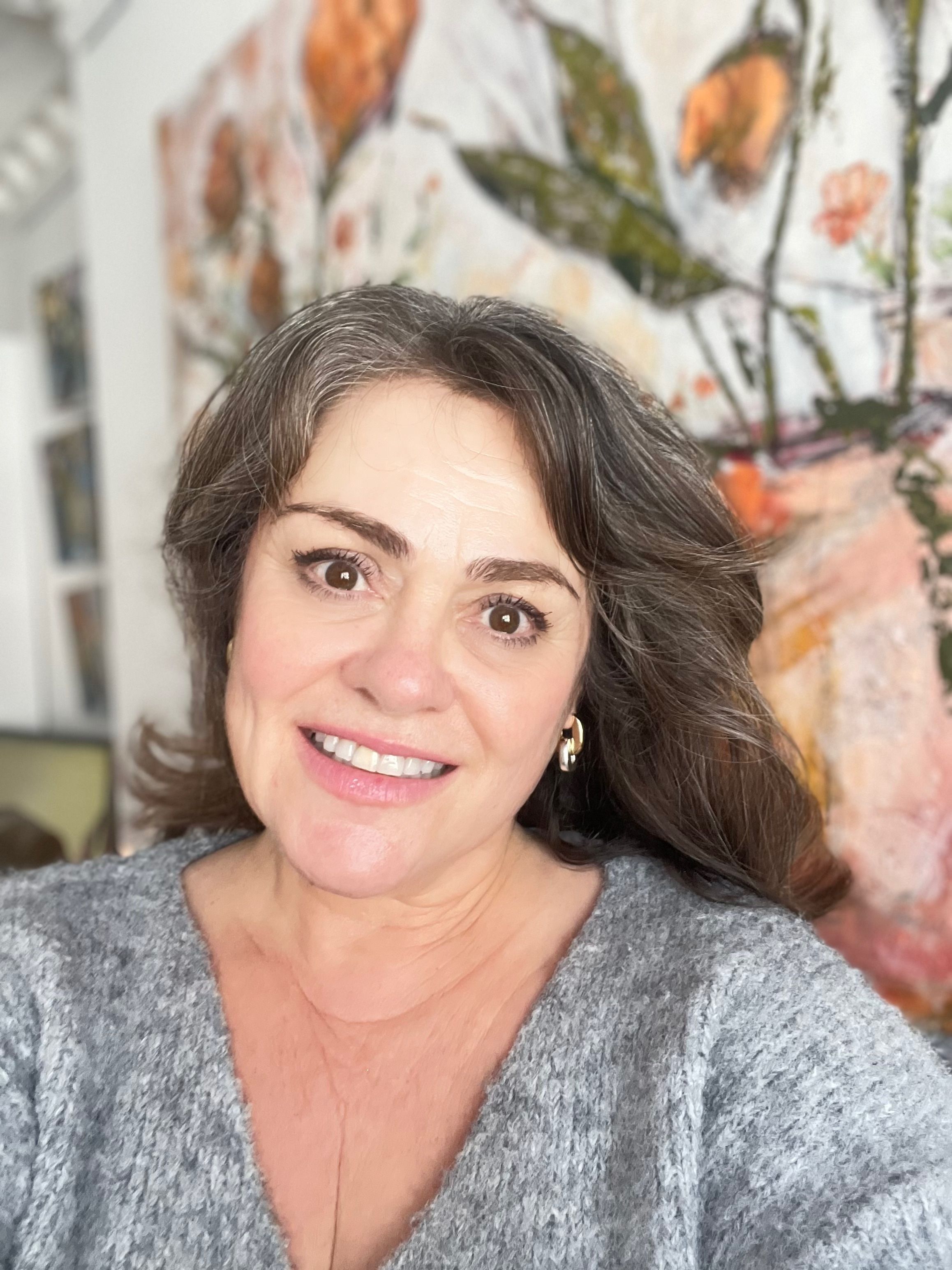
Christie Baker is a self-taught, contemporary Canadian painter based in Toronto. Since her first exhibition in 2022, she has developed a growing professional practice, with work presented in galleries, juried and curated exhibitions, art fairs, corporate environments, and private collections across Canada and internationally.
Working primarily in acrylic and mixed media, Baker draws on the language of still life to investigate relationships between materials, memory, and domestic space. Her paintings bring together vessels, botanical forms, and architectural motifs, often on reclaimed textiles and raw linen. Vessels function as portraits of family history, while spatial relationships between objects, through repetition, fragmentation, and intervals, create compositions that extend beyond the individual forms.
Baker’s practice has been enriched by artist residencies in Canada and France, including Hôtel Sainte-Valière, La Maison de Beaumont, Gibraltar Point, and six months on the Gatineau River in Gatineau Park, Quebec. A published writer of creative non-fiction and personal essays, she brings a parallel interest in narrative and observation to her visual practice.
Baker serves as Vice Chair and Incoming Chair of the Artists’ Network Board of Directors. She is an Associate Member of the Society of Canadian Artists and a member of the Federation of Canadian Artists.
ARTIST’S STATEMENT
I am interested in what happens when materials and objects are allowed to have a presence of their own.
My practice begins with a belief in the material nature of painting. Acrylic, reclaimed textiles, raw linen, ink, charcoal, and oil pastel are not simply means to depict an image; each retains its own character, history, and physical presence. I build paintings in which material, surface, and image remain in conversation rather than resolving into a single, fixed reading.
I use still life as a framework for exploring relationships between objects, space, and memory. Vessels become individual portraits; arrangements of vessels and other familiar forms become family portraits. I am interested in how these relationships are constructed through proximity, distance, repetition, overlap, fragmentation, and interruption. The spaces between objects are not empty—they are active elements that shape the composition and alter how each form is perceived.
Through layering and erasure, and through the tension between raw and painted surfaces, I allow the process of making to remain visible. Forms can dissolve, repeat, fragment, or extend beyond the edge of the painting, moving between recognition and abstraction. Paint remains paint; textile remains textile. Their physical identities are part of the meaning of the work.
I think of each painting as a living field of relationships, where no element exists entirely on its own. Objects, materials, surfaces, and spaces continually affect one another, creating paintings that are familiar yet unresolved, grounded in the physical world yet open to multiple ways of seeing.