
Valentina Campos
VALENTINA CAMPOS CV
1999- Modern Museum of Art in La Paz, Bolivia; art biennale SIART, third mention.
1999- “Dieu Donne Gallery”, New York City, U.S.A Fellowship. Collective show.
2000-Casa de la Cultura Raúl Otero Reiche, Santa Cruz, Bolivia. 2000-Galeria das Artes “Tribo do Sol”, Salvador, Bahia. Brasil.
2001-The Sacred Stone Gallery, New Mexico, U.S.A. Solo exhibition.
2002-Arpana Caur Gallery, New Delhi, India, “Navdanya” organized by Vandana Shiva.
2003-Galeria de Arte “Gildaro Antezana”, Cochabamba, Bolivia
2005-Bolivian Embassy in Washington D.C, U.S.A, collective exhibition “Latina”, women in the arts.
2006-Lexington Downtown Art Center, Kentucky, U.S.A.
2008-International Museum of Women, “Imagining Ourselves” San Francisco California, U.S.A. book online.
2009-“Art City Gallery”, Asheville, North Carolina, U.S.A.
2010-Resource Center of the Americas, Minneapolis, U.S.A. collective exhibition.
2011- Centro cultural “Kasa Kamasa”, collective exhibition
2012- “Casa de la Cultura”, Cochabamba, Bolivia, solo exhibition.
2014- Galeria “Taypi” La Paz Bolivia. Solo exhibition.
2016- Galeria de Arte “Gildaro Antezana”, Cochabamba, Bolivia “Arte y Resistencia”
2019- “Galeria Arte y Cultura Sucre”, Sucre, Bolivia, solo exhibition “Mamalas”
2019-International Art Museum of America, San Francisco - California, U.S.A.
2021- Woman Made Gallery, virtual exhibition, Chicago, U.S.A
2023- Rainbow International Art Gallery, Asheville NC
2025- Art Connects Women, ZeeArts, Dubai UAE
ARTIST’S STATEMENT
Valentina Campos Statement
When I was a child I used to paint with my grandmother, with my mother, on the walls, on the floor, at school, on the streets with chalk, with mud...
I painted from my mind in the sky when I was somewhere where I was not allowed to paint.
During the the socio-political crisis, my family went through dark and difficult times. It was necessary to migrate to the country. There the peasant families lived another world parallel to the civilize one. With them (and also with my grandmother) I learned about nurturing and caring for the community of plants, the community of animals, the community of spirits. Nurturing and allowing each other to be nurture. I always used to see the member’s spirits of each community.
Later, traveling alone through the communities of Norte Potosi, I learned how women sing songs to each of the seeds for their growth. They were lovingly treated as a daughter, a sister, a mother... Immediately I imagined all of them and transported them to my canvas.
I continue to be inspired, to be filled with admiration and awed, by the abundance of feminine myths and tales that I have discovered about seeds, plants, and food, and by cultural and biological diversity itself. My paintings are not only a personal channel to express the intimate sense of nature that I deeply identify with, but also a bridge to communicate, transmit, and educate others about the message of traditional wisdom.
Returning to earth is no longer an option but a responsibility. To return in a renewed way, to heal, to recreate our memory and ancestral practices, is for me an urgency in the face of the socio-cultural denigration in which we find ourselves.
I feel that my series of paintings "Mamalas, seeds source of life" will never end, given the infinity of biodiversity and its spirits that guide and inspire me to paint them.
Appreciations to Valentina’s work:
Jessica Lagunas (United States)
Valentina, I especially love your painting of the woman with the braids up. It seems to me of great energy and hope.
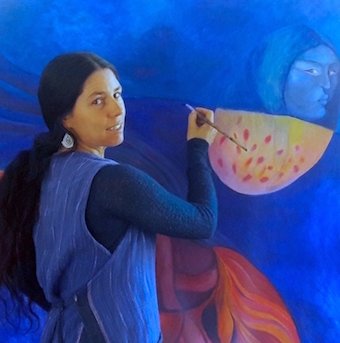
Your portrait with the painting behind is also beautiful ...
Maria Lopez (Mexico)
I love your paintings. I think that you have your own style, they do not remined me of other painters. I can see the Andean feminine spirit
Felicidad’s Valentina!
I love your paintings. I think that you have your own style, they do not remined me of other painters. I can see the Andean feminine spirit
Felicidad’s Valentina!
Ruby Pan (Singapore)
I love the imagery in your paintings, a sense of rootedness and connection with the earth that I don't have being a child of the city. They remind me of Frida Kahlo's paintings. Maybe I have to invent my own traditions...
Henry Costelo (U.S)
Tu arte es realmente bonito. Pareces un poco a la Kahlo, pero tu tienes mas limpieza, mas ternura....
Mounira Al Solh (Lebanon)
We should be able to choose what to preserve from our traditions and what to get rid of. In the Middle-East women and men are traditionally curious about other people's private life. They want to know things that they shouldn’t know: who kissed who, and who has more money... This is bad and annoying!
Another habit is that they are very generous and helpful, this is good and they should preserve it!
The thing most wanted when I travel to Bolivia, Cochabamba was to meet the artist Valentina Campos. I caught the bus, after she guided me throw the phone. You need to be on your toes with the transportation in Bolivia. It’s never what you expect. A few minutes later he picked up a mother and grandmother. I asked them if they knew if the bus went passed the Toll. Lucky for me: “Estes Aqui.” she informed me.
” Hola”, in a soft feminine voice. I turned around to see a petite woman with brown eyes and curly dark hair tied back . Valentina warmly reached out and gave me a hug.
” Valentina?!” I half exclaimed and half questioned. ” Is this the house?”
” Si Si, ” Her two small boys played around her. they were gorgeous.
Valentina’s paintings hung on the walls, even more stunning in the flesh. This faced double doors which lead out to the garden where more of Valentina’s paintings regally hung to tell their intricately woven stories. It was amazing to see them in their actual oil painted glory. Large and powerfully beautiful.
We sat at the dining room table, Valentina had made a coca tea and a batch of Quinoa treats.
Valentina softly explained her work. I knew that she worked with different communities of women. She had with her many publications what she and her community produces. A third generation Bolivian Artist, an activist, a writer and here is me thinking Valentina is simply an incredible painter. Her activism works towards the betterment of her people. Since 1991 she has worked with indigenous peasants in several communities. She helps to promote ancient ways of farming and food production her research always revolving around agriculture and the Andean cosmovision. There are many rituals centered around farming and the sacred grains.
Currently Valentina is working at the “Uywana Wasi”, a community of local indigenous farmers and artists in the town of Totorkawa; Cochabamba, Bolivia, promoting and celebrating the regional cultural affirmation.
As I sipped tea and Valentina chewed coca leaves. I told her of my idea for a company. I asked her opinion on working with women to produce my designs.
” Do you think an idea like this goes against the movement you are trying to promote, which is keeping the ancient traditions in tacked and not trying to modernize or change them?”
She pondered for a while and finally said,
” I don’t think so, As long as what you are doing comes from a meaningful place and is symbolic and true to you. I think there are some women who would be interested in working with you.”
Coming from Valentina this made me happy. She is the real deal not only has she founded groups to promote farming but also She has engaged in projects with Guaranies, Chiquitanos and Ayoreos tribes, designed to assist women and youth in the rediscovery and rescue of lost art forms. Valentina co-founded “Kunaymana”, a co-operative of Aymara women from two communities of Lake Titicaca, created to rescue, protect, and strengthen culture and agriculture, as of late prioritizing the crucial processes of cultural affirmation and mental decolonization.
Valentina walks the walk and talk the talk. Living the words she speaks.
We talked at length about how movements in the west are trying to return to ancient ways of wisdom, because of the realization that “modern society” has depleted the planet and in many ways we have lost a little of our culture from globalization. We talked of natural childbirth, Valentina organized an international delegation consisting of traditional midwives and women activists to participate in and present a workshop “The Ecology and Culture of Normal Birth”, at the world Social Forum, Porto Alegre, Brazil.
I mean...Is there nothing this woman can’t do? She is incredible! It shows that with an honest heart, true intentions and trust acceptance is possible. I sat in disbelief that I was actually here and actually meeting this incredible woman with so many talents yet so open and humble.
Finally, we walked through the house and Valentina talked me through her paintings. In 2000 Valentina began creating a series of paintings, entitled “Siembra de Mamalas”, reflecting sowing rituals, the role of women in the Andean cosmovision, and the protection of biodiversity. Valentina said she is often very inspired by weaving and the stories involved. Each painting wove an intricate story of a legend entwined with a political message. Valentina always manages to make something poignant and so strikingly beautiful out of, often, a tragic message or situation.
I thanked Valentina for all of her wisdom, pleased I has had the opportunity to meet such an incredible spirit.